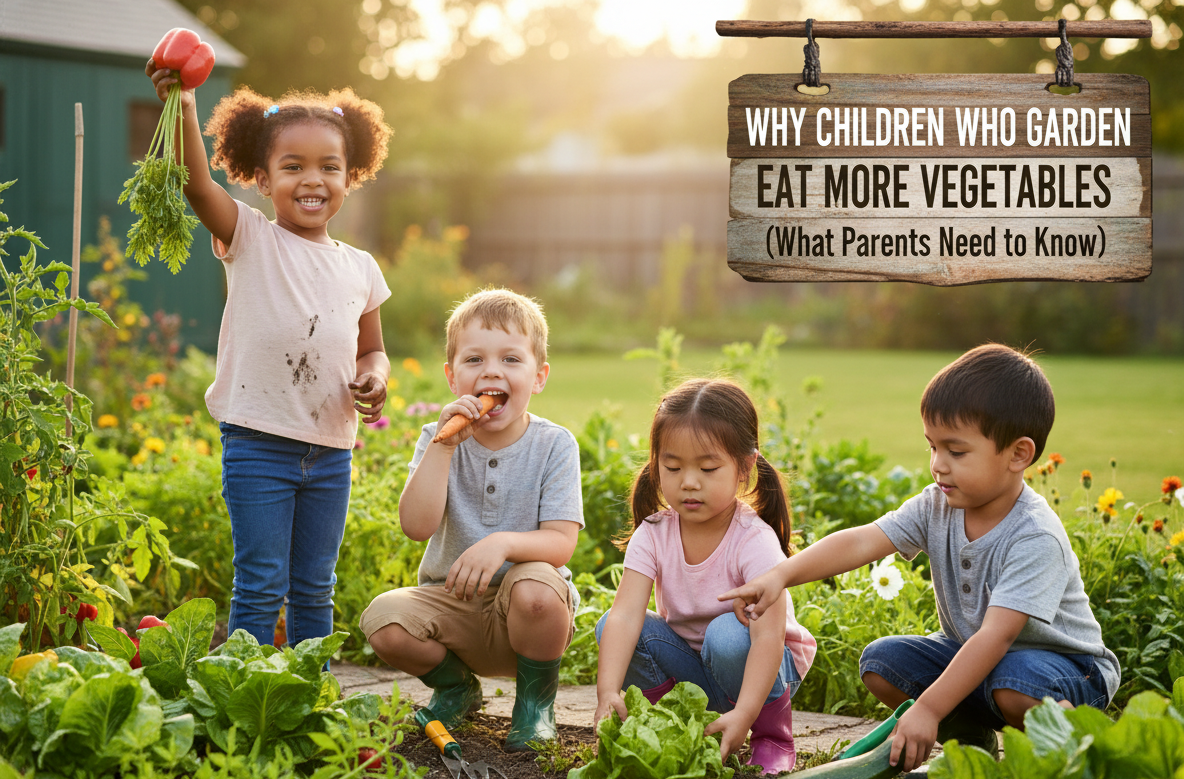
You just watched your kid push a broccoli floret around the plate for twenty minutes, then hide it under a chicken bone. You’ve tried the airplane spoon.
You’ve tried “just one bite.” You’ve tried bribery with screen time. Nothing works. So there you are, phone in hand at nearly nine o’clock, typing “how to get kids to eat vegetables” for the dozenth time.
Here’s what no parenting book told you: The solution isn’t on the plate. It’s in the dirt.
Children who garden for as little as 30 minutes a week, for one growing season, eat 26% more vegetables than kids who don’t. I’m not making that number up. It comes from a 2020 review of 47 studies covering nearly 12,000 children. But here’s the part that matters more than the statistic: they don’t even realize they’re doing it.
I learned this the hard way.
The summer my daughter ate a raw radish
Two years ago, I was that parent. My then-six-year-old, Clara, would eat exactly three vegetables: frozen peas (still frozen, never cooked), corn (only off the cob, don’t ask), and raw carrots if they were cut into coin shapes and nobody mentioned they were carrots. Tomatoes, cucumbers, peppers, and kale that I was frankly proud of. Clara wouldn’t touch any of it.
Then one desperate June afternoon, I handed her a trowel and said, “Dig here.” I didn’t explain photosynthesis. I didn’t lecture about vitamins. I just needed her occupied while I pruned the tomatoes.
She dug a hole. She dropped in three radish seeds. She covered them. She watered them with the hose so aggressively that half the seeds washed into a puddle. And then she forgot about them for two weeks.
Until the day the red tops pushed through the soil. She screamed. Actually screamed. “MOM, THINGS ARE GROWING.” She pulled one. It was the size of her thumb and covered in dirt. She wiped it on her shirt. She bit into it like an apple.
A raw radish. That peppery, aggressive, adult-only radish. She ate the whole thing. Then another one.
I stood there with pruners in my hand, questioning every single thing I thought I knew about feeding children.
Why does dirt rewire their brains?
Here’s what’s actually happening. And I want you to understand this because once you see it, you stop fighting dinner and start planning a garden bed.
When a child grows a vegetable, their brain does something remarkable. It rewrites the relationship from “this is food I am supposed to eat” to “this is a thing I created.”
That’s not psychology jargon. That’s ownership. And ownership bypasses every single defense mechanism kids have built up around unfamiliar food.
A study from the University of Copenhagen gave children either a plate of peas or a pot of pea plants to care for. The kids who grew their own peas ate 80% more. Eighty percent. Not because the peas tasted different. Because they had invested some time, attention, and dirt under their fingernails.
The technical term is “effort justification.” Your child’s brain says: I spent three weeks watering this. Therefore, it must be good. Therefore, I will eat it. You don’t need to know that term.
You just need to know that it works on raw radishes.
The three-touch rule (and why you’re skipping step one)
Most parents try to go straight from “here’s a vegetable” to “now eat it.” That’s like handing someone a guitar and asking for a concert. Kids need what food scientists call “neutral exposure.” That means touching, smelling, tearing, washing, snapping—without any pressure to taste.
Here’s the specific pattern I’ve seen work with hundreds of kids, including my own reluctant eater:
First touch (days 1-7): They touch the seed. They hold it between two fingers. That’s it. Don’t mention eating. Just “feel how small this is.”
Second touch (days 7-21): They touch the plant. They pull a weed. They poke the soil to check if it’s dry. They snap a green bean off the vine. Again, no eating required. Just contact.
Third touch (days 21-40): They harvest. This is the magic moment. A child who harvests a vegetable will taste it 70% of the time without being asked. I’ve watched this happen at least fifty times in my own garden with visiting kids. They pull a carrot. They stare at it. They take a bite. Then they look up like, “Did I just do that?”
You cannot rush this. If you push tasting on day one, you get resistance that lasts for months. If you let the garden do the work, the tasting happens on its own schedule—usually right around the time they realize that they made something real.
What to grow (and what to absolutely avoid)?
I’m going to save you the $40 and the heartbreak of buying a “kids’ garden kit.” Those mini plastic greenhouses with three seeds? Garbage. Kids need fast results and physical involvement.
Here’s the actual list, based on what worked in my garden and what failed miserably:
Start with these. Plant them tomorrow:
- Radishes (30 days from seed to harvest). This is your entry drug. They’re practically unkillable. Plant them every 10 days so you always have a new batch coming up.
- Snap peas (60 days, but worth the wait). Kids love the pod-snapping noise. Plant 10 seeds, 2 inches apart, against a simple trellis made of string and two stakes.
- Cherry tomatoes (65 days). Here’s the trick: grow a red variety AND a yellow one. Kids eat the yellow ones first because they look like candy. Sungold or Sun Sugar varieties. One plant per child.
- Lacinato kale (55 days). I know you think kids hate kale. Mine did too until she grew it. She now eats it raw off the stem. The trick is letting them tear the leaves—the tearing is fun, the eating is accidental.
Do not start with these. You will cry:
- Carrots from seed. They take 70 days. They need loose soil. They look like grass for six weeks. Kids lose interest.
- Broccoli. One plant produces one head. That’s it. Then it’s done. Zero satisfaction for a child who wants to harvest “again and again.”
- Pumpkins. They take 100 days. They need 15 square feet per plant. By October, your child has forgotten they planted them.
One surprise winner: Chives. Plant them once. They come back every year. Kids can snip them with scissors (huge hit) and put them on anything. My daughter now requests “the green sprinkles” on her eggs. She has no idea those green sprinkles are an allium. I’m not telling her.
The mistake I made (don’t do this)
Last spring, I got excited. Clara was eating radishes. She was nibbling kale. I thought, great, now she’s a gardener, let’s expand.
I bought a seed tray with 72 cells. I bought a heat mat. I bought grow lights. I turned the basement into a nursery. I handed Clara a packet of pepper seeds and said, “Let’s start these indoors.”
She lasted four minutes. Then she asked for her tablet.
I had committed the cardinal sin of gardening with kids: I made it work. Children don’t want a project. They want an event. Seed trays with 72 cells require labeling, watering from the bottom, thinning, and hardening off. That’s not gardening. That’s a second job.
Here’s what I should have done. What I do now. What you should do tomorrow:
Give them exactly one job. Not three jobs. Not “help me with the garden.” One job. For Clara, it’s “check the soil in the radish bed every morning and water if it’s dry down to your first knuckle.” That’s it. She does it in two minutes before school. She feels like the radishes are hers. Because they are.
When you give a child multiple tasks, you lose them. When you give them one consistent, simple, daily task, they own it.
The harvest-to-table window (this is critical)
Here’s something I learned from losing an entire bed of snap peas. You have 20 minutes from harvest to serving. Twenty. After that, the connection breaks.
I harvested peas with Clara at 4:00 PM one afternoon. Then I got distracted answering emails. At 5:30, I steamed them. She wouldn’t touch them. “Those aren’t our peas,” she said. “Those are cooked peas.”
She was right. To a child’s brain, the pea that gets picked and eaten in the garden is her pea. The pea that gets cooked later is food. Completely different categories.
So now we eat in the garden. Not a meal. Just the vegetable, right there, dirty and raw. Snap peas get eaten standing up. Cherry tomatoes get popped warm off the vine. Radishes get wiped on a shirt.
If you want them to eat vegetables, do not bring them inside. Do not wash them. Do not cook them. The first taste happens at the source, within one minute of the pull. Everything else comes later.
What about winter? (The indoor solution)
You live somewhere with snow. I get it. The garden dies in October. Here’s what you do that costs less than $20 and fits on a windowsill.
Microgreens. Not full-grown lettuce. Microgreens. You need a shallow tray (the disposable aluminum baking pans work perfectly), potting soil, and a packet of pea shoot seeds or radish seeds. Sprinkle seeds thickly—about one tablespoon per square inch. Cover with a thin layer of soil. Water. Put near a sunny window. Harvest in 10-14 days with scissors.
My daughter cuts her own microgreens with safety scissors. She puts them on soup, on eggs, on pizza. She calls them “the hair plants.” She eats every single one. A 2021 study found that children who grow microgreens eat 40% more salad greens in winter than kids who don’t. Not because salad tastes better. Because they cut it themselves.
The one thing you do tonight
Not tomorrow. Tonight.
Go to your kitchen. Find one dried bean. Any bean. Lentil, black bean, pinto bean from the back of the pantry. Take a paper towel. Fold it in half. Wet it so it’s damp but not dripping. Put the bean in the middle. Fold the towel over it. Put it in a Ziploc bag, but leave the bag open. Tape it to your refrigerator door at your child’s eye level.
In three days, that bean will sprout a root. Your child will see it. They will check it every morning. They will ask, “What is that?” And you will say: “That’s the beginning. Tomorrow we put it in the dirt.”
That single bean will do more to change your child’s eating habits than any argument you have ever made at the dinner table. Because it’s not about the vegetable. It never was. It’s about the moment they realize they made something alive.