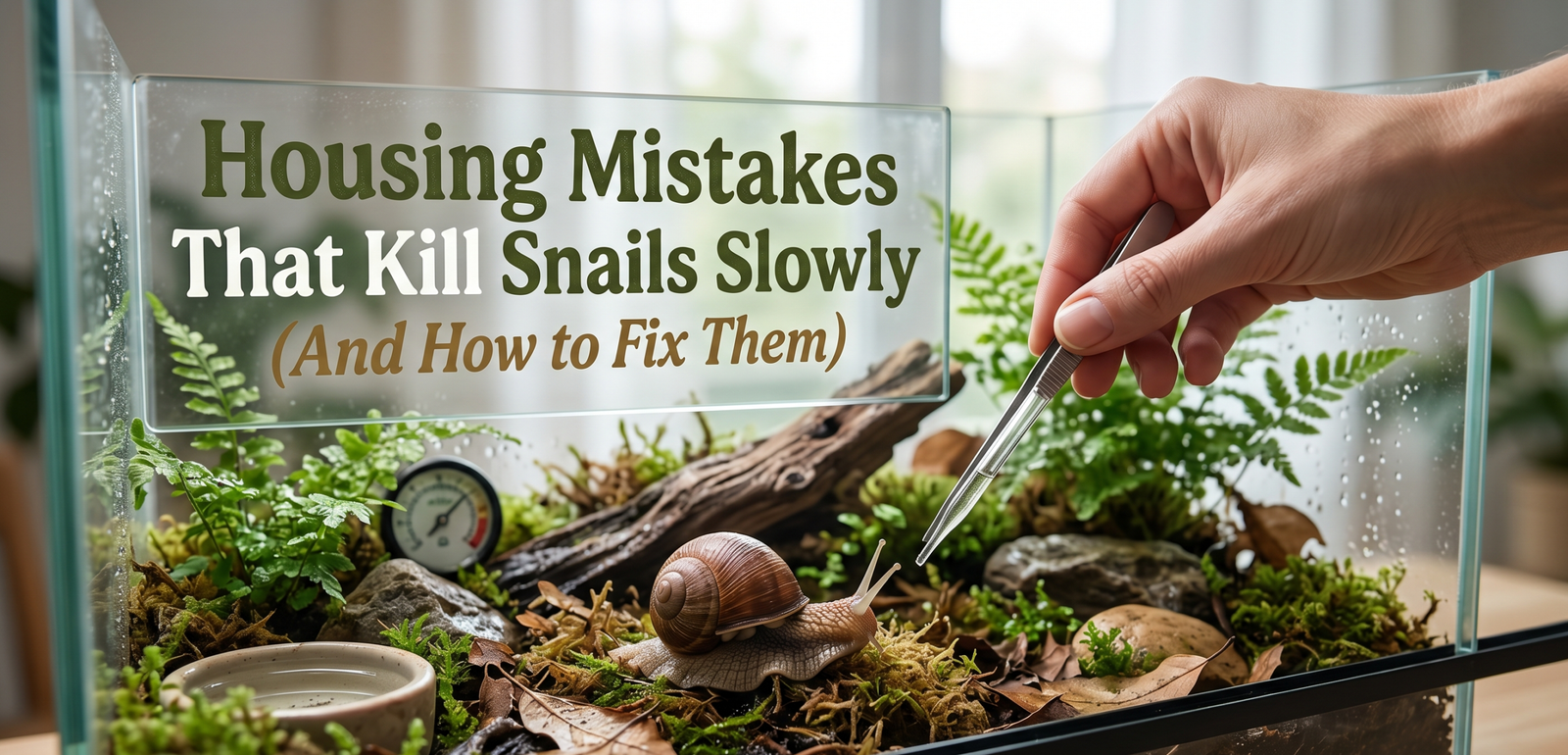
Most snail deaths are not sudden. They happen over days or weeks, driven by slow, invisible stressors inside the enclosure. If your snail is retreating into its shell for too long, moving less, eating poorly, or showing a dull, flaky shell, the habitat is likely the problem, not disease.
Wrong Humidity Levels Dehydrate or Drown Snails
Snails are highly sensitive to moisture. Too little humidity causes dehydration, which leads to prolonged hibernation, a shrivelled body, and eventually death. Too much moisture creates anaerobic conditions at the substrate level, promoting harmful bacteria and fungal growth that damage the snail’s foot and mantle.
Most land snails, including the popular Giant African Land Snail (Achatina fulica), require humidity between 75% and 90%. Garden snails (Cornu aspersum) do well around 70–80%.
How to maintain correct humidity:
- Mist one side of the enclosure daily, leaving the other side slightly drier.
- Use a digital hygrometer — visual guessing is inaccurate.
- Ensure the lid has ventilation to prevent stagnant, waterlogged air.
Poor ventilation combined with over-misting is one of the leading housing mistakes that slowly kills snails, because the damage builds invisibly over weeks.
Substrate That Is Toxic, Too Shallow, or Completely Wrong
The substrate is where snails spend most of their time burrowing, laying eggs, and resting. Using the wrong material is one of the most overlooked mistakes keepers make.
Substrates that harm snails:
- Gravel or sand alone: abrasive to the foot and offers no moisture retention.
- Potting mixes with perlite, fertilisers, or pesticides: these chemicals are absorbed through the foot and cause organ failure over time.
- Cedar or pine shavings: the natural oils are toxic to snails and most invertebrates.
Safe substrate options:
- Organic, additive-free coconut coir (coco peat).
- Plain topsoil with no added chemicals.
- A mix of coco coir and organic soil at a ratio of 1:1.
Depth matters too. Snails burrow to lay eggs and regulate their own temperature. A substrate depth of at least 3–4 inches (7–10 cm) is the minimum. Too shallow, and the snail cannot engage in natural behaviour, which causes chronic stress and suppresses the immune system.
For further guidance on safe substrates, the Royal Society for the Prevention of Cruelty to Animals (RSPCA) maintains general invertebrate care standards that apply directly to snail keeping.
Enclosure Size That Restricts Movement and Growth
A container that is too small creates a stressful environment where waste accumulates quickly, the snail cannot exercise normally, and shell growth becomes stunted. Stunted shells are a direct sign of chronic stress and calcium deficiency — both worsened by cramped housing.
Minimum enclosure guidelines by species:
- Small snails (under 3 cm): 5–10 gallon tank.
- Medium snails like Cornu aspersum: 10–15 gallon tank.
- Large snails like Achatina fulica: 15–20 gallon tank minimum, larger for groups.
The enclosure should be at least three times the snail’s shell length in height so it can fully extend and move naturally. Plastic tubs, glass tanks, and wooden vivariums all work — but they must be sealed against escape while allowing airflow.
Incorrect Temperature That Slows Organ Function
Temperature controls digestion, metabolism, and immune response in snails. Housing them outside their preferred temperature range does not kill instantly — it causes a slow decline in organ efficiency, appetite, and shell production.
Most common pet snails thrive between 18°C and 26°C (65°F–79°F). Temperatures below 15°C trigger hibernation. Temperatures above 30°C cause heat stress and dehydration, even if humidity is adequate.
Common temperature mistakes:
- Placing the enclosure near a window with direct sunlight can cause heat spikes.
- Keeping the tank in a cold room in winter without supplemental heating.
- Using heat mats designed for reptiles directly under the snail tank — these can overheat the substrate and bake the snail from below.
If supplemental heat is needed, a low-wattage ceramic heat emitter mounted on the side of the tank is safer than an under-tank heater for snails.
Using Tap Water Directly on or Around Snails
Chlorine and chloramines in municipal tap water are toxic to snails when used for misting or as a drinking source. The exposure accumulates, damaging the gill-like tissues snails use for gas exchange and causing shell erosion over time.
Safe water options:
- Dechlorinated tap water (leave in an open container for 24 hours or use a dechlorinator like sodium thiosulfate).
- Filtered or bottled spring water (not distilled — distilled lacks minerals).
The snail’s shell requires calcium carbonate to grow properly. Mineral-depleted water, combined with calcium-poor substrate, creates shells that crack, peel, and become pitted — all signs of a housing environment that is slowly failing the animal.
Calcium Deficiency Caused by a Bare Enclosure
Calcium is the structural foundation of the snail shell. Without adequate dietary calcium, the shell thins, becomes brittle, develops holes, and eventually the snail loses the ability to protect itself or retract fully.
This deficiency is not a feeding problem alone — it is a housing problem. The enclosure must contain a permanent calcium source that the snail can access freely and on its own schedule.
Calcium sources to keep inside the enclosure at all times:
- Cuttlebone (widely available in pet stores).
- Crushed oyster shell mixed into the substrate.
- Plain, unflavored eggshells, dried and baked at 200°C for 10 minutes.
- Natural calcium powder is dusted onto food several times per week.
According to research published through JSTOR’s biology archives, calcium uptake in land snails is continuous, meaning a single calcium supplement with meals is often insufficient. The snail needs to self-regulate its intake, which is only possible when calcium is freely available in the enclosure at all times.
Poor Ventilation That Builds Up Ammonia and CO₂
A sealed or poorly ventilated enclosure accumulates carbon dioxide from the snail’s respiration and ammonia from waste decomposition. Both gases are harmful at elevated concentrations and cause respiratory distress, erratic behaviour, and retraction into the shell.
Many keepers mistake inadequate ventilation for correct “humidity maintenance.” The two goals are not in conflict — you can maintain humidity while still providing adequate airflow by using a mesh-covered lid or drilling ventilation holes covered with fine mesh.
Signs of poor ventilation:
- A sour or ammonia smell when the lid is opened.
- Condensation covers every surface inside the tank, not just one wall.
- The snail spends extended periods on the enclosure lid or walls (trying to escape the air quality at ground level).
Clean the enclosure fully every 2–4 weeks, remove uneaten food within 24 hours, and spot-clean waste daily to reduce ammonia buildup between full cleans.
Overcrowding That Spreads Disease and Increases Aggression
Snails kept in groups produce more waste, consume calcium sources faster, and are exposed to parasites or bacteria if one individual is sick. Overcrowding is particularly dangerous because it looks harmless at first — snails appear social and clustered together.
Safe stocking density:
- 1–2 large snails per 10-gallon enclosure.
- No more than 4–5 medium snails per 15-gallon enclosure.
- Monitor for shell damage, which indicates aggression or crowding stress.
New snails should always be quarantined for 2–4 weeks before introduction. Many snail diseases, including nematode infections and bacterial shell rot, spread through direct contact and shared substrate.
Sudden Environmental Changes That Shock the Snail’s System
Snails adapt slowly. Abruptly moving them from one temperature or humidity level to another causes physiological shock. This is why seemingly healthy snails sometimes die within days of being moved to a new enclosure, rehomed, or placed in a renovated tank.
When making changes to the enclosure — such as a new substrate, a new layout, or a temperature adjustment — transition gradually over several days. Introduce a new substrate by layering it over the existing substrate rather than replacing the entire substrate at once. Allow the snail time to adjust rather than making all changes simultaneously.
How to Audit Your Snail’s Housing Right Now?
If you suspect your housing setup is contributing to a slow decline, run through this checklist:
- Humidity: Measure with a hygrometer. Is it in the correct range for your species?
- Substrate: Is it chemical-free, at least 3–4 inches deep, and moisture-retentive?
- Temperature: Check at floor level, not just at the top of the enclosure.
- Water source: Are you misting with dechlorinated water?
- Calcium: Is cuttlebone or an equivalent always available inside the tank?
- Ventilation: Does the enclosure smell clean when opened?
- Enclosure size: Can the snail fully extend and move without obstruction?
- Stocking density: Is each snail getting adequate space and calcium access?
Correcting even two or three of these factors can produce visible improvement in snail activity, appetite, and shell condition within one to two weeks.
Final Thoughts
Housing mistakes that kill snails slowly are rarely dramatic. They are gradual failures, slightly wrong humidity, marginally too cold, and a calcium source that ran out last week. The animal compensates for a while, then cannot. By the time the decline is obvious, the damage is often weeks old.
The solution is to build a habitat that meets the snail’s needs consistently, not reactively nmeasure humidity, and source safe substrate. Keep calcium available. Dechlorinate water. These are not complex requirements, but they must be maintained without gaps.
For species-specific care standards, the Snail and Slug Specialist Group under the IUCN provides additional resources on land snail biology that can help keepers make more informed housing decisions.