
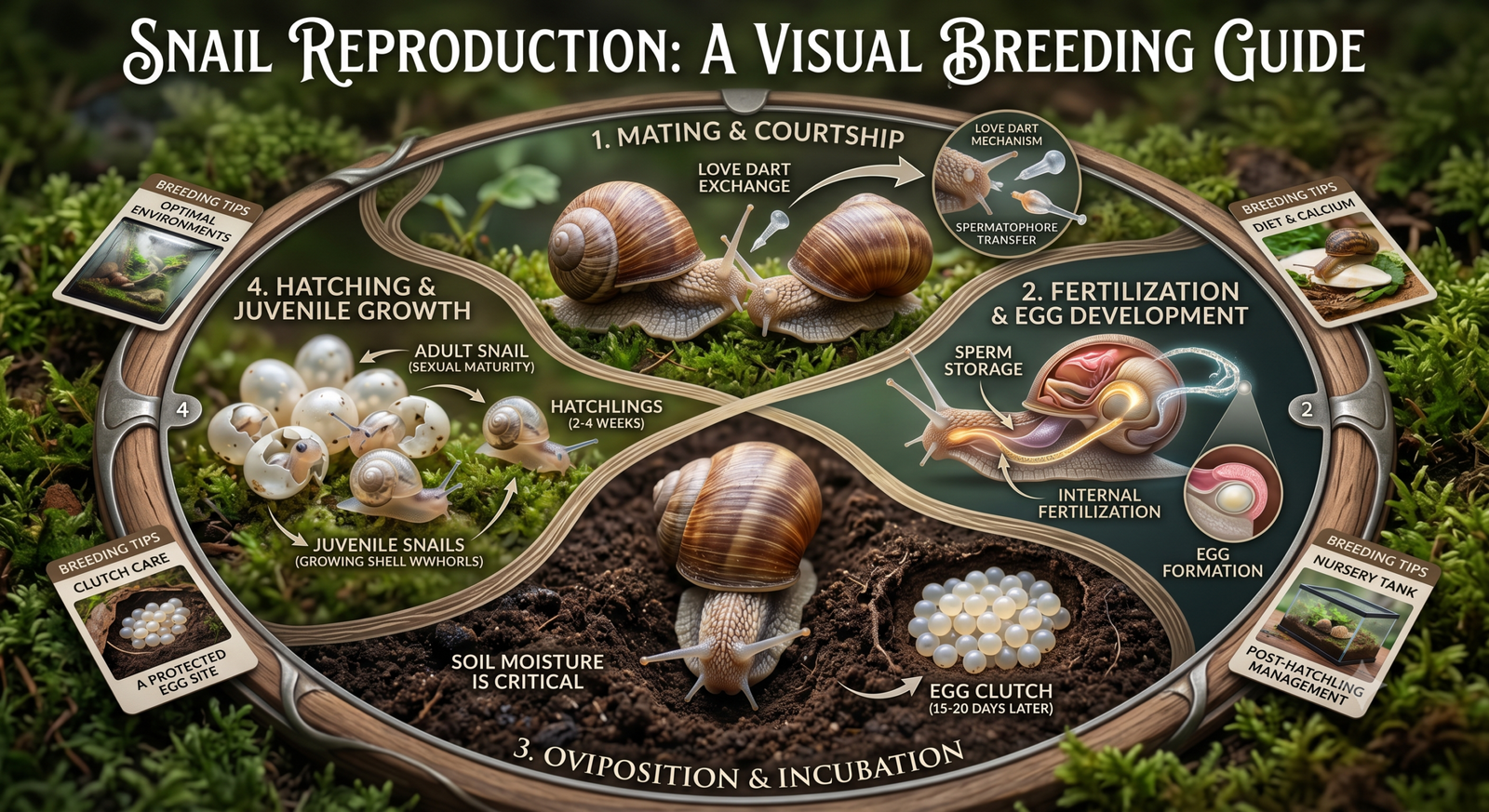
Snails reproduce through a fascinating process that combines hermaphroditism, courtship rituals, and careful egg-laying.
Whether you’re raising garden snails, land snails, or aquatic species, understanding how they breed helps you manage populations or support successful captive breeding.
Are Snails Male or Female?
Most land snails are hermaphrodites, meaning each individual carries both male and female reproductive organs. This doesn’t mean they fertilise themselves — in almost all cases, two snails still need to mate.
The advantage is that any two snails of the same species can pair up, which increases breeding opportunities.
Some aquatic snails, like mystery snails (Pomacea bridgesii), are exceptions — they have distinct sexes and require a male and female to reproduce. Knowing your species matters before setting up a breeding environment.
The Mating Process Step by Step
Courtship
Before mating, land snails engage in a courtship period that can last anywhere from 2 to 12 hours. They circle each other, touch antennae, and press their bodies together. This isn’t just instinct — it’s a compatibility check.
Garden snails (Helix aspersa) are well-known for firing a “love dart,” a calcium-coated spike shot into the partner’s body.
Research from the University of Michigan’s Animal Diversity Web confirms this dart increases the chance of sperm survival by altering the recipient’s reproductive chemistry.
Sperm Exchange
Once courtship is complete, both snails exchange sperm simultaneously. Each snail stores the received sperm in a structure called the spermatheca, where it can remain viable for months.
This means a snail can fertilise eggs long after the original mating event.
Egg Fertilization
After sperm storage, the snail begins producing eggs internally. The stored sperm fertilises the eggs before they’re laid. A single mating session can lead to multiple clutches of eggs over time — without needing to mate again.
When Do Snails Mate?
Most land snails breed in spring and early summer when conditions are warm and moist. Rainfall triggers mating activity, which is why you see snails more active after rain. In captivity, you can encourage breeding by:
- Keeping humidity between 70–90%.
- Maintaining temperatures between 18–24°C (65–75°F).
- Providing a calcium-rich diet for shell and egg development.
- Misting the enclosure regularly.
Aquatic snails breed year-round in stable tank conditions, making them prolific in home aquariums.
How Do Snails Lay Eggs?
After fertilisation, a snail finds a safe, moist location to deposit eggs. Land snails typically dig 2–5 cm into soft soil or hide eggs under logs, rocks, or leaf litter. This protects the clutch from drying out and from predators.
A garden snail lays between 30 and 120 eggs per clutch and may produce several clutches per year. The eggs are small, round, and white or cream-colored, roughly 3mm in diameter.
Giant African land snails (Achatina fulica) can lay up to 200 eggs per clutch, which is why their population management is critical in areas where they’re invasive.
According to the Food and Agriculture Organisation of the UN, giant African land snails cause significant agricultural damage globally due to their rapid breeding rate.
Snail Egg Incubation Period
Incubation time depends on species and temperature:
| Species | Incubation Time | Temperature |
|---|---|---|
| Garden snail (Helix aspersa) | 2–4 weeks | 20–22°C |
| Giant African land snail | 10–21 days | 25–28°C |
| Mystery snail (aquatic) | 2–4 weeks | 24–27°C |
| Ramshorn snail | 10–20 days | 22–25°C |
Warmer temperatures generally speed up hatching. Cooler temperatures slow development but don’t necessarily damage eggs as long as they don’t dry out or freeze.
What Do Snail Eggs Look Like?
Land snail eggs resemble small pearls — white, slightly translucent, and clustered together. As the embryo develops, the egg becomes less opaque. If an egg stays completely white without any change after 2 weeks, it may be infertile.
Aquatic snail eggs look different by species. Mystery snail eggs are laid above the waterline in a pink or coral-colored clutch that hardens over time. Ramshorn snails lay clear, gel-like egg clusters directly on aquarium surfaces.
How to Breed Snails in Captivity?
Setting Up the Enclosure
Use a well-ventilated plastic or glass enclosure with a secure lid. Snails are escape artists. The enclosure should be at least 10 gallons for a pair of medium-sized snails, larger for giant species.
Substrate matters. Use a mix of coconut fibre and topsoil at a depth of 5–8 cm for egg-laying. Avoid soil with fertilisers or pesticides — these are toxic to snails.
Feeding for Breeding
A calcium-rich diet is essential for egg production and shell health. Offer:
- Cuttlebone or crushed eggshells for calcium.
- Leafy greens like kale, lettuce, and spinach.
- Carrots, zucchini, and cucumber.
- Commercial snail food as a supplement.
Protein sources like boiled egg or fish flakes can boost breeding activity, especially in giant African land snails.
Pair Selection
For hermaphroditic species, any two adults of the same species work. Avoid pairing juveniles — most land snails reach sexual maturity between 6 months and 2 years, depending on species. Garden snails mature around 6–8 months; giant African land snails typically take 6–12 months.
Caring for Snail Eggs and Hatchlings
Once you find an egg clutch in the enclosure, avoid disturbing it. Eggs need consistent humidity — mist lightly if the substrate feels dry. Don’t move the eggs if possible; the position and orientation matter for development.
When hatchlings emerge, they’re fully formed miniature versions of adults. They immediately start eating the shell of their own egg for calcium, which is normal behaviour. Move hatchlings to a separate enclosure to prevent adults from accidentally crushing them.
Feed hatchlings the same diet as adults but in smaller portions:
- Finely grated vegetables.
- Crushed cuttlebone.
- Small amounts of protein once per week.
Hatchlings grow quickly in warm, humid conditions. Expect visible shell growth within the first 2–3 weeks.
Common Breeding Problems
Eggs Not Hatching
If eggs don’t hatch past the expected incubation window, they may be infertile. Infertile eggs turn yellow or begin to mould. Remove them promptly to prevent contamination of healthy eggs.
Low temperature is another cause. Check that your enclosure isn’t too cool — especially at night.
Snails Not Mating
Adult snails that refuse to mate are often stressed, too young, or not getting enough calcium. Review diet and environmental conditions. Sometimes, simply introducing a new snail from a different batch stimulates mating behaviour.
Overcrowding
Snails breed readily in captivity, and populations can grow faster than expected. A single pair of garden snails can produce hundreds of offspring in a year. Plan your colony size and separate breeding pairs if needed to control numbers.
Aquatic Snail Reproduction: Key Differences
Aquatic snails like nerite snails, mystery snails, and ramshorn snails follow different rules.
Nerite snails require brackish water to hatch eggs successfully — eggs are laid in freshwater tanks but rarely hatch there. This makes them popular in aquariums because they won’t overpopulate.
Mystery snails require both sexes. The female stores sperm and lays clutches above the waterline. Keeping the tank level a few inches below the lid allows space for egg-laying. The eggs drop into the water when ready, or you can carefully remove and float the clutch just above the surface.
Ramshorn snails are hermaphroditic and reproduce quickly. They can become invasive in tanks — a single snail can theoretically produce offspring through self-fertilisation under certain conditions, though cross-mating is far more common. The Aquarium Science organisation notes that ramshorn populations can double in weeks under ideal conditions.
Snail Reproduction Facts Worth Knowing
- Land snails can store sperm for up to a year after mating.
- A garden snail can lay 6 clutches per year, totalling 480+ eggs.
- Not all eggs in a clutch are fertile — 20–30% infertility is normal.
- Snails don’t care for their young after hatching.
- Giant African land snails are banned in the US due to agricultural and ecological risk.
- Snail eggs can survive mild desiccation but not full drying.
Final Thoughts
Snail reproduction is a slow, methodical process that rewards patient observation. Whether you’re breeding giant African land snails for food, garden snails as pets, or managing aquarium species, the biology stays consistent: mate, store sperm, lay eggs, and wait. Control humidity, temperature, and calcium intake, and most healthy snail pairs will breed without intervention.
For deeper species-specific guidance, the Royal Horticultural Society’s snail biology pages and ITIS Taxonomic Database offer reliable reference material for identifying species and understanding their reproductive cycles.
