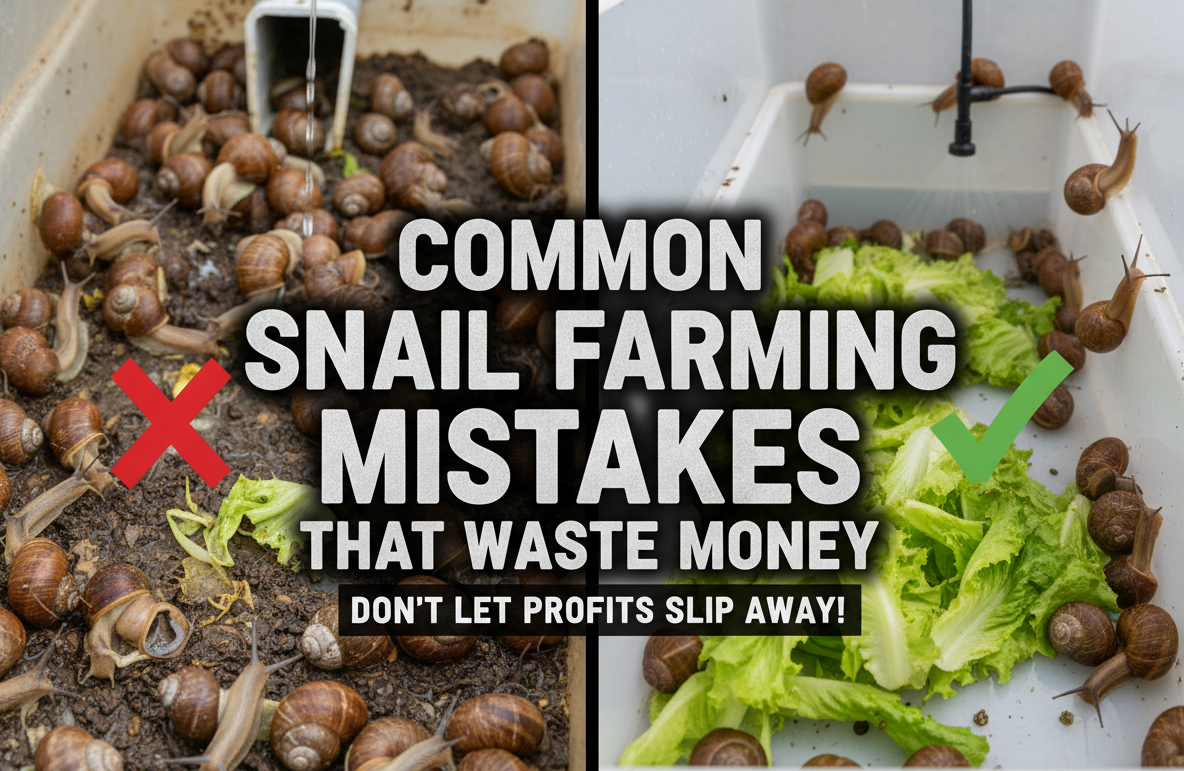
Snail farming looks simple on paper. Low startup cost, high demand, and small land requirement. But most beginners lose money in the first two years, not because heliculture doesn’t work, but because they repeat the same avoidable mistakes. This article breaks down exactly where money gets wasted in snail farming and what to do instead.
Choosing the Wrong Snail Species for Your Climate
The most expensive mistake happens before you buy a single snail.
Farmers in West Africa often stock Achatina achatina (Giant African Land Snail) without checking if their microclimate supports it. In areas with long dry seasons and low humidity, this species suffers high mortality rates. The result: you restock repeatedly, which drains capital fast.
What to do instead:
- Match your species to your region’s humidity and temperature range.
- Achatina fulica survives drier conditions better than Achatina achatina.
- Helix pomatia suits temperate European climates, not tropical ones.
- Consult your local agricultural extension office before purchasing stock.
The Food and Agriculture Organization (FAO) has documented species-climate compatibility guidelines that most small farmers never read. That document alone could save thousands in restocking costs.
Starting With Unhealthy or Wild-Caught Breeding Stock
Buying from random markets or collecting snails from the wild introduces disease and genetic weakness into your farm from day one.
Wild snails carry parasites. They’re also stressed from handling, which suppresses their immune systems and reduces reproduction rates. A breeding snail that doesn’t reproduce for three months is dead money.
Signs of unhealthy stock:
- Cracked or thin shells.
- Retraction deep into the shell when touched.
- Mucus that is watery rather than thick.
- Visible wounds on the foot.
Always buy breeding stock from a certified heliculture farm. Ask for health records. Pay the extra cost upfront — it prevents a total stock loss later.
Wrong Pen Design Wastes Feed, Water, and Snails
Many beginners build pens based on what they see on YouTube, not on what works for their specific environment.
Common pen design errors:
- No shade cover: direct sunlight raises the temperature and dries snails out.
- Poor drainage: waterlogged soil causes foot infections and drowning.
- No escape-proof barrier: snails climb smooth surfaces; a 45-degree overhang or a water moat stops them.
- Overcrowding: recommended density is 50–100 snails per square meter, depending on age; exceeding this stunts growth and spreads disease.
A poorly built pen doesn’t just lose snails, it wastes every input cost: feed, calcium supplements, water, labor.
The International Centre of Insect Physiology and Ecology (ICIPE) has published research on optimal snail housing structures for tropical climates. It’s worth reading before you pour a single bag of cement.
Feeding the Wrong Things at the Wrong Time
Snails don’t eat everything. And what you feed them directly determines shell quality, body weight, and market value.
Calcium is non-negotiable. Without enough calcium, snails produce thin, brittle shells that crack during transport. Cracked shells mean rejection at the market. You don’t get paid.
Common calcium sources:
- Crushed oyster shells.
- Limestone powder.
- Eggshells (dried and ground).
- Bone meal.
Feeding timing errors:
Snails are nocturnal. They feed most actively at night and in the early morning. Farmers who scatter food at midday see most of it go uneaten, dry out, and rot — creating ammonia buildup in the pen that harms snails.
Feed in the evening. Remove uneaten food the next morning. This single habit reduces feed waste by up to 40%.
Safe foods to feed:
- Pawpaw leaves and fruit.
- Cabbage.
- Lettuce.
- Banana peels.
- Sweet potato leaves.
- Watermelon.
Foods to avoid:
- Salt or salty scraps (lethal to snails).
- Citrus fruits in large amounts (acidity disrupts digestion).
- Pesticide-treated vegetables (cause mass die-offs).
Ignoring Humidity and Temperature Management
Snails need 75–95% relative humidity to thrive. Below that range, they aestivate — they seal their shells and go dormant. A snail in aestivation is not growing, not reproducing, and not converting feed into marketable weight.
Farmers in hot, dry seasons often see their stock go dormant for weeks without understanding why. They assume the disease. They treat for parasites. Nothing changes. The real problem is humidity.
How to manage humidity without expensive equipment:
- Water the pen floor lightly each evening (don’t flood it).
- Use a mulch layer (dried leaves, coco peat) to retain soil moisture.
- Position the pen to face away from prevailing dry winds.
- Use shade netting on the south and west sides in hot climates.
Temperature range for optimal growth: 20–30°C. Above 32°C, snails become stressed. Below 10°C, growth stops entirely.
A basic thermometer and hygrometer cost less than $10. Not owning one is a false economy.
No Biosecurity Plan
One infected batch can wipe out an entire farm in weeks.
Snails spread disease through contact with each other, shared tools, and contaminated soil. Most farmers have no quarantine protocol. New stock goes straight into the main pen. If that stock carries nematodes or shell rot disease, the whole population is exposed immediately.
Basic biosecurity steps:
- Quarantine new snails for 2–3 weeks in a separate pen.
- Disinfect tools between pens using a diluted bleach solution.
- Remove dead snails from the pen daily; rotting snail bodies are a disease vector.
- Don’t allow visitors to handle snails without protective gloves.
- Source your feed from pest-free suppliers.
According to research published by CABI, nematode parasites and Pseudomonas bacterial infections are among the leading causes of mass snail mortality in commercial operations. Both are preventable with basic hygiene protocols.
Harvesting Too Early or Too Late
Harvesting before snails reach maturity means low body weight and a thin shell less money per unit. Harvesting too late ties up pen space and increases feed costs without proportional weight gain.
How to know a snail is ready for harvest:
- The lip of the shell (the outer rim) is thickened and hard.
- Body weight: Achatina achatina should reach 100–450g at maturity.
- Age: typically 8–12 months from hatching, depending on conditions.
The hardened lip is the most reliable indicator. Don’t rely on age or weight alone; growth rates vary widely based on feed quality and climate.
No Market Plan Before Production
This is where many technically skilled farmers still fail.
Growing thousands of snails without a buyer lined up means you’re selling at whatever price the market offers — usually low, because you’re desperate to move stock before it degrades.
Before your first batch reaches harvest size, you should already have:
- At least two confirmed buyers (restaurants, processors, exporters, or market traders).
- A clear price per kilogram agreed in writing.
- Knowledge of whether your buyer wants live, frozen, or processed snails.
- Packaging that meets the buyer’s specification.
Snail export markets, particularly to Europe, have strict requirements around size, hygiene, and species documentation. The European Commission’s food import regulations outline exactly what’s required for snail exports. Ignoring these means rejection at customs — and you absorb the shipping cost with nothing to show for it.
Underestimating Record-Keeping
Farmers who don’t track data repeat costly mistakes season after season.
At minimum, track:
- Number of snails stocked per pen.
- Feed type and quantity are used weekly.
- Mortality rate by pen and by month.
- Harvest weight per batch.
- Revenue per batch.
Without these numbers, you can’t tell which pen design works, which feed formula drives faster growth, or whether your operation is actually profitable after costs. You’re farming blind.
A simple notebook or a free spreadsheet on your phone is enough to start.
Trying to Scale Before the System Works
Scaling a broken system only scales the losses.
If you’re losing 30% of stock per season on a 500-snail operation, buying 5,000 snails doesn’t solve the problem — it multiplies it. Every input cost multiplies: feed, labor, water, and housing.
Get one pen to a consistent survival rate above 85% and a profitable harvest before expanding. That means:
- Understanding your local mortality patterns.
- Having a stable feeding routine.
- Knowing your buyer and your price point.
- Running at least two full harvest cycles.
Only then does scaling make financial sense.
Final Point
Common snail farming mistakes that waste money aren’t complicated — they’re predictable. Wrong species, bad housing, poor feed timing, no biosecurity, and no market plan account for most farm failures. Fix these before spending more money on stock or equipment, and your operation becomes genuinely profitable.
Snail farming works. The farmers who lose money are almost always making one of the errors listed above, not facing some unavoidable market problem. Diagnose your operation honestly, fix the specific gap, and your unit economics will follow.