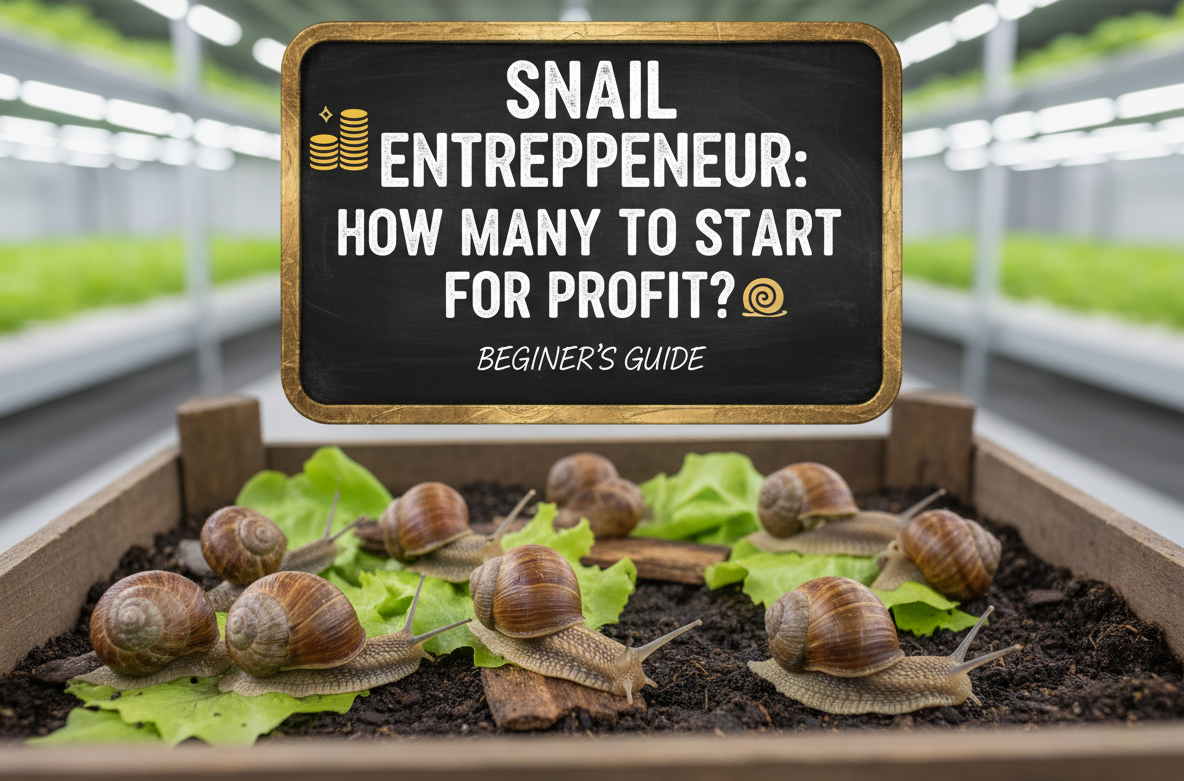
Launching a heliciculture venture offers a unique path to agricultural success with relatively low entry barriers. However, the most frequent hurdle for newcomers is determining the initial scale of their stock. To build a sustainable income stream, a beginner should ideally start with 500 to 1,000 breeder snails.
Starting with this volume allows you to account for natural mortality rates while ensuring your first harvest is large enough to interest commercial buyers. A smaller batch of 50 to 100 snails is excellent for learning the ropes, but rarely generates a meaningful financial return in the first year.
Why Initial Stock Volume Dictates Your Success?
The number of snails you purchase today determines your inventory levels twelve months from now. Snails are prolific breeders, but they require a specific “critical mass” to make the labour of daily feeding and cleaning worth your time.
If you start too small, your expansion will be sluggish. You will spend the first two years simply waiting for your population to grow rather than selling product. Conversely, starting with over 2,000 snails without prior experience often leads to management burnout and high loss rates.
The Mathematics of Snail Procreation
Most profitable species, such as Helix aspersa or Achatina achatina, are hermaphrodites. This means every individual in your farm has the potential to lay eggs after mating.
A single healthy breeder can produce between 200 and 400 eggs annually. If you start with 500 breeders, you are looking at a potential second-generation population of 100,000 snails, assuming high survival rates and optimal conditions.
How Many Snails Should Beginners Start With for Profit?
For a beginner aiming for a part-time profit, the sweet spot is 500 breeders. This number is manageable for one person to handle in roughly 10 hours of work per week.
- Learning Phase (50–100 Snails): Best for hobbyists. You will learn about humidity, feed preferences, and soil pH without financial risk.
- Micro-Commercial Phase (500–1,000 Snails): The ideal starting point for profit. This volume produces enough “slime” for cosmetic extraction or meat for local restaurants.
- Small-Scale Industrial (2,000+ Snails): Requires dedicated infrastructure and potentially hired help, and is recommended only if you have a pre-signed contract with a distributor.
According to research from the Food and Agriculture Organisation (FAO), proper stocking density is vital to prevent stunted growth and disease outbreaks. Overcrowding 500 snails into a tiny space will negate the benefits of a higher starting count.
Selecting the Right Species for Maximum Returns
Not all snails are created equal when it comes to the marketplace. Your choice of species will dictate your climate requirements and your end-buyer.
Petit Gris (Helix aspersa aspersa)
This is the “gold standard” for the European restaurant trade. They mature quickly, usually within 6 to 10 months. They are smaller than African varieties but command a higher price point per kilogram in gourmet markets.
Gros Gris (Helix aspersa maxima)
A larger version of the Petit Gris, these are favoured for their meat yield. They are resilient and adapt well to various climates, making them a top choice for beginners in temperate zones.
Giant African Land Snail (GALS)
Species like Achatina achatina are massive and produce significant amounts of meat. However, they are restricted in many regions (including parts of the US) due to their status as invasive species. Always check local agricultural regulations before importing these.
The Cost of Entry: Stocking vs Infrastructure
Your budget should be split between purchasing your initial stock and building the snailery (their habitat).
| Item | Estimated Cost (500 Snails) | Notes |
|---|---|---|
| Breeder Stock | $250 – $500 | Price varies by species and age. |
| Fencing/Netting | $100 – $200 | Prevents escapes and bird predation. |
| Soil & Substrate | $50 – $100 | Must be calcium-rich and pesticide-free. |
| Feeding Trays/Tools | $30 – $70 | Basic plastic trays and misters. |
Investing in high-quality breeders is more important than fancy housing. “Spent” snails—those that have already reached their reproductive peak—are often sold cheaply but will yield poor results for a new farmer.
Environmental Controls for Breeding Success
Snails are sensitive to their surroundings. If the environment isn’t ideal, they will enter a state of dormancy (estivation or hibernation), halting your profit cycle.
Soil Composition and Calcium
Your snails need calcium to build their shells. Without it, they will rasp at each other’s shells, leading to death and loss of stock.
- Maintain a soil pH between 6.5 and 7.5.
- Provide supplemental calcium carbonate or crushed eggshells.
- Ensure the soil is loose enough for egg-laying.
Humidity and Temperature
Most profitable snails thrive in 75% to 90% humidity. If you live in a dry area, an automated misting system is not a luxury; it is a necessity for a 500-unit farm. Temperatures should ideally range from 15°C to 25°C.
Feeding for Growth Velocity
To turn a profit quickly, you must move your snails from hatchling to market size as fast as possible. While snails can survive on kitchen scraps, a “profit-first” diet is more structured.
- Leafy Greens: Lettuce, cabbage, and spinach provide hydration and bulk.
- Fruit: Watermelon and papaya are excellent for rapid growth.
- Formulated Mash: A mix of maize, soybeans, and vitamins ensures they get enough protein to build muscle (meat).
Avoid salty foods at all costs. Salt is lethal to snails and can wipe out your entire 500-snail investment in hours.
Managing Mortality: Expecting the Unexpected
A common mistake beginners make is assuming that every snail they purchase will survive. In reality, a 10% to 15% mortality rate is standard, even for experienced farmers.
Causes of loss usually include:
- Predators: Rats, birds, and ground beetles.
- Dehydration: Forgetting to mist the pens during a heatwave.
- Parasites: Often introduced through poor-quality soil.
Starting with 500 snails, losing 50 individuals is a setback, but it doesn’t end your business. If you started with only 20 snails and lost 15, your venture would effectively be over.
Marketing Your Snail Harvest
Profit isn’t realised until the product is sold. Before your 500 breeders produce their first 50,000 offspring, you need to identify your buyers.
- Local High-End Restaurants: Chefs often prefer fresh, locally raised snails over canned imports.
- Cosmetic Labs: Snail mucin (slime) is a massive trend in skincare. This requires specific extraction equipment but offers high margins.
- Export Markets: Countries like France, Italy, and Greece have insatiable appetites for snails, but meeting strict international health standards is required.
Financial Projections for Year One
In your first year, your primary “profit” is the expansion of your stock.
- Months 1-3: Focus on keeping the 500 breeders alive and encouraging mating.
- Months 4-6: Egg laying and hatching. You may have 20,000+ tiny snails.
- Months 7-12: Growth phase. The first batch reaches market size.
If you sell 1,000 kg of snail meat at an average price of $10-$20 per kilo (depending on your region), the ROI on your initial 500-snail purchase becomes very clear.
Common Pitfalls to Avoid
Many beginners fail because they treat snail farming as a “set it and forget it” hobby.
- Escapes: Snails are surprisingly good at climbing. Use “electric fencing” (low-voltage tapes) or specialised netting to keep your profits inside the pen.
- Overstocking: As your 500 snails multiply, you must build more pens. If you keep 5,000 snails in a space meant for 500, they will stop growing.
- Poor Record Keeping: Track your feed costs against your growth rates. This is the only way to know if your business is actually profitable.
Scaling Your Operation
Once you have mastered the care of 500 snails, scaling to 5,000 or 50,000 is a matter of duplicating your systems. The biology remains the same; only the logistics of waste management and feed procurement change.
Most successful commercial farmers started exactly where you are—with a manageable number of breeders and a commitment to understanding the unique needs of these molluscs.
Final Summary of Stocking Strategy
To ensure a profitable outcome, skip the “starter kits” of 10 snails. They are toys, not business tools. Secure a batch of 500 healthy, young breeders from a reputable supplier.
Focus on environmental stability and high-protein nutrition. By the end of your first full breeding cycle, your initial investment will have multiplied into a significant biological asset, providing the foundation for a long-term, high-margin agricultural business.