
Farmed snails should be priced between $0.19-$1.27 USD per individual snail based on size, or $3,000 USD per kilogram for wholesale live snails. Small snails (150-200g) command $0.19-$0.32 each, while extra-large breeding stock reaches $0.76-$1.27 per snail.
Value-added processed products can increase revenue to $4,500 per kilogram, representing a 50% markup over live snail pricing.
What Factors Determine How Much You Should Charge for Farmed Snails?
Snail pricing depends on five primary factors: size/weight, market channel, processing level, geographic location, and seasonal demand. Size represents the most significant pricing variable, with large snails (300g+) commanding triple the price of small ones (150g).
Weight-based pricing tiers follow established market standards:
- Small snails (150-200g): ₦300-500 each ($0.19-$0.32 USD).
- Medium snails (200-300g): ₦500-800 each ($0.32-$0.51 USD).
- Large snails (300g+): ₦800-1,200 each ($0.51-$0.76 USD).
- Extra-large breeding stock: ₦1,200-2,000 each ($0.76-$1.27 USD).
Market channel selection significantly impacts pricing power. Restaurants and hotels pay premium rates for consistent supply and specific sizes, while wholesale markets prioritize volume over margins. Direct-to-consumer sales through farmers’ markets or online platforms typically yield 25-40% higher prices than wholesale channels.
Common pricing mistake: Setting uniform prices regardless of snail size. Markets clearly differentiate pricing based on weight categories, and farmers should align with these established tiers to maximize revenue.
How Much Should You Charge for Farmed Snails in Different Markets?
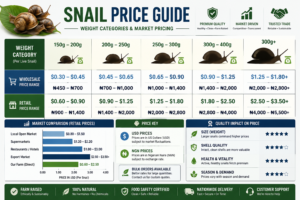
Live snail pricing varies significantly by geographic market and distribution channel. Lagos markets represent Nigeria’s premium pricing tier at ₦600-800 per individual mature snail, while Ogun State averages ₦500-700 per snail due to lower market pressure.
Regional pricing breakdown:
- Lagos (premium market): ₦600-800 per snail.
- Ogun State (secondary market): ₦500-700 per snail.
- Rural markets: ₦400-600 per snail.
- International wholesale: $3,000 USD per kilogram.
Distribution channel pricing:
- Restaurant direct sales: 20-30% above wholesale rates.
- Hotel contracts: Premium pricing for consistent supply.
- Wholesale markets: Baseline commodity pricing.
- Export markets: Higher margins but require quality certifications.
Market timing strategy: Prices fluctuate seasonally, with peak demand during holiday periods and cultural celebrations. Farmers should track local market cycles and adjust pricing accordingly, potentially holding inventory during low-price periods if storage capacity allows.
Edge case consideration: New farmers should start with competitive pricing slightly below market rates to establish customer relationships, then gradually increase prices as reputation and quality consistency develop.
What Premium Can You Charge for Processed Snail Products?
Value-added processing allows farmers to charge significantly higher prices than live snail sales. Processed snail products command $4,500 USD per kilogram compared to $3,000 for live snails, representing a 50% revenue increase through blanching and shelling processes.
Processing premium pricing:
- Live snails: $3,000 USD per kilogram (baseline).
- Blanched/shelled: $4,500 USD per kilogram (+50% premium).
- Frozen escargot meat: $9,000 USD per kilogram (200g packs at $1,800 each).
- Fresh preparation kits: $2,500 USD per pack.
Processing considerations: The $1,500 per kilogram processing premium must cover additional costs, including labor, equipment, packaging, and potential spoilage. Farmers should calculate net margins after processing expenses to determine profitability.
Market positioning strategy: Processed products target different customer segments than live snails. Restaurants prefer ready-to-cook preparations, while specialty food retailers focus on packaged consumer products.
Decision rule: Choose processing if you have reliable cold storage, consistent quality control, and established relationships with restaurants or specialty retailers. Stick to live sales if infrastructure or market access is limited.
How Should Seasonal Demand Affect Your Snail Pricing?
Snail prices fluctuate 10-25% throughout the year based on supply cycles and cultural demand patterns. Peak pricing periods align with holiday seasons and cultural celebrations when snail consumption increases significantly.
Seasonal pricing strategy:
- Peak season (holidays/festivals): Increase prices 15-25% above baseline.
- Regular season: Maintain standard market pricing.
- Low season (rainy periods): Consider 10-15% discounts to move inventory.
- Supply shortage periods: Premium pricing opportunities.
Supply management: Unlike seasonal crops, snail farming allows some control over harvest timing. Farmers can adjust feeding and growth cycles to align mature snails with high-demand periods.
Inventory considerations: Live snails require ongoing care and feeding costs. Extended holding periods during low-price seasons may erode profit margins through maintenance expenses.
Common mistake: Harvesting all snails simultaneously without considering market timing. Stagger harvests to capture seasonal price premiums and maintain consistent cash flow.
What Pricing Strategy Works Best for New Snail Farmers?
New snail farmers should implement a penetration pricing strategy, starting 10-15% below established market rates to build customer relationships and market presence. This approach prioritizes market entry over maximum short-term profits.
New farmer pricing framework:
- Research local market rates for each size category.
- Set initial prices 10-15% below market to attract customers.
- Focus on quality consistency to justify future price increases.
- Gradually increase prices as reputation develops.
- Match market rates once the customer base is established.
Customer acquisition tactics:
- Offer volume discounts for repeat customers.
- Provide consistent sizing and quality.
- Maintain reliable supply schedules.
- Build relationships with restaurant buyers.
Pricing evolution timeline: Most successful farmers reach market-rate pricing within 6-12 months of operations, assuming consistent quality and reliable supply.
Risk management: Avoid pricing too far below market rates, as this can create customer expectations that are difficult to change and may signal quality concerns to potential buyers.
How Do Quality Standards Impact Snail Pricing?

Premium quality snails command 20-30% price premiums over standard market rates through consistent sizing, health certification, and reliable supply chains. Quality differentiation becomes increasingly important as markets mature and customers develop preferences for specific suppliers.
Quality premium factors:
- Consistent sizing: Uniform weight within categories.
- Health certification: Disease-free stock verification.
- Shell condition: Clean, undamaged shells.
- Supply reliability: Consistent delivery schedules.
- Traceability: Farm-to-table documentation.
Quality control systems: Implement grading processes that separate premium snails from standard stock. Premium grades justify higher pricing while standard grades compete at market rates.
Certification benefits: Organic or sustainable farming certifications can support premium pricing, particularly for export markets or high-end restaurant customers.
Customer education: Communicate quality differences to justify premium pricing. Restaurants and retailers will pay more for consistent products that reduce their operational risks.
Final Thoughts
Determining how much to charge for farmed snails requires balancing multiple factors, including size categories, market channels, processing levels, and regional demand patterns. The baseline pricing of $3,000 USD per kilogram for wholesale live snails provides a foundation, but successful farmers optimize pricing through size-based tiers, value-added processing, and quality differentiation strategies.
FAQ
What’s the minimum viable price for farmed snails?
The minimum viable price covers production costs plus basic profit margin. For most operations, this ranges from $2,000-$2,500 USD per kilogram for live snails, well below the $3,000 market rate.
Should I price snails individually or by weight?
Use individual pricing for retail sales and restaurant customers, and weight-based pricing for wholesale. Individual pricing allows better margin capture on larger snails.
How often should I adjust snail prices?
Review prices monthly and adjust quarterly based on market conditions, seasonal demand, and cost changes. Avoid frequent price changes that confuse customers.
What’s the profit margin on processed vs live snails?
Processed snails offer higher revenue per kilogram but require additional costs. Net margins depend on processing efficiency and market access for value-added products.
Do organic snails command premium pricing?
Yes, organic certification can support 15-25% price premiums in markets that value sustainable farming practices, particularly export and high-end restaurant segments.
How do I handle price negotiations with bulk buyers?
Set minimum acceptable prices based on production costs, offer volume discounts rather than base price reductions, and emphasize quality and reliability benefits.
What payment terms should I offer customers?
Cash on delivery for new customers, net 15-30 days for established restaurant accounts. Longer payment terms may justify slight price premiums.
Should I match competitor pricing exactly?
Price competitively within 5-10% of market rates, but differentiate through quality, service, or reliability rather than competing solely on price.
How do transportation costs affect pricing?
Include delivery costs in pricing for local sales, charge separately for distant customers. Transportation typically adds 5-15% to final customer costs.