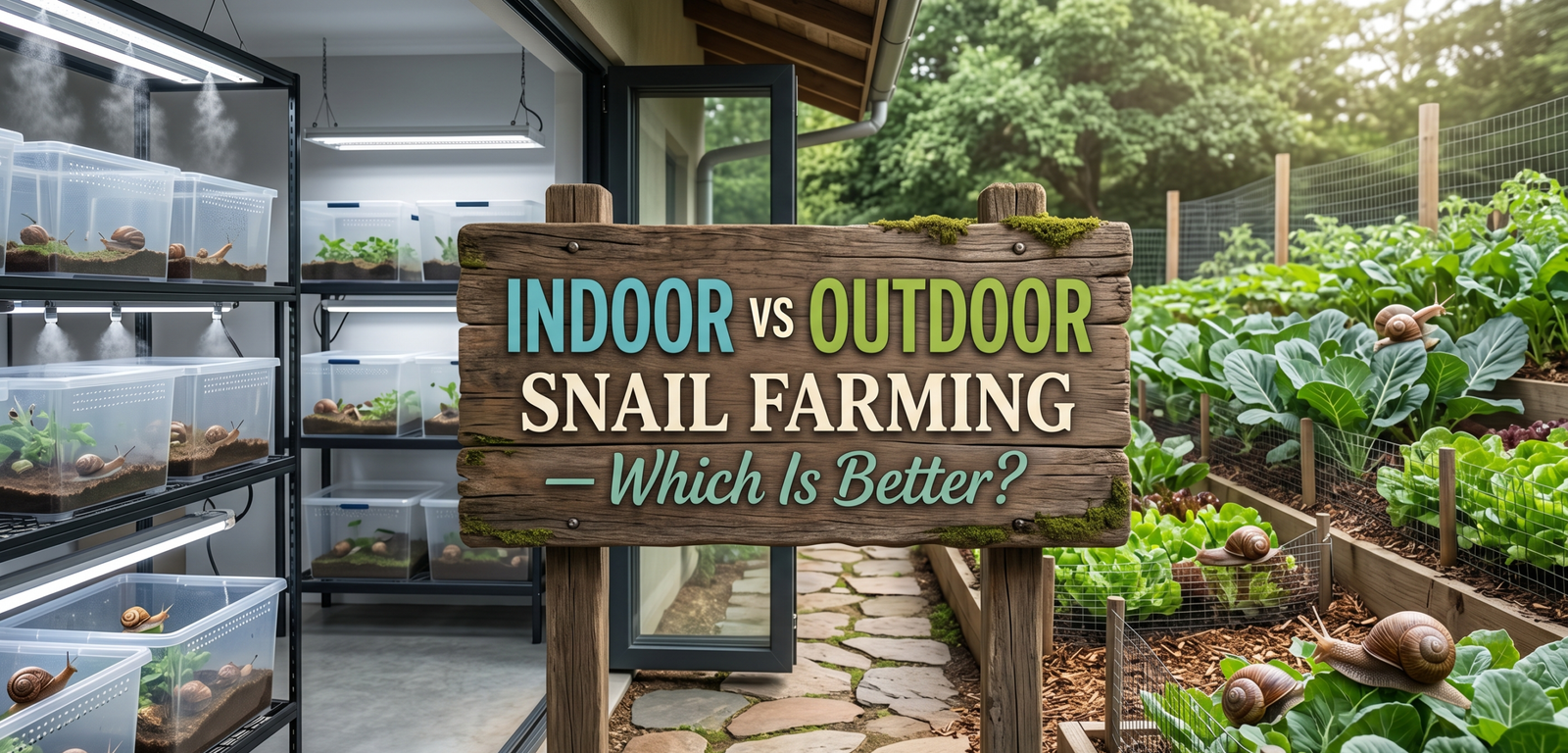
Choosing between indoor and outdoor snail farming is one of the first and most consequential decisions any snail farmer makes. The wrong setup wastes money, slows growth, and increases losses. The right one matches your climate, budget, and scale — and turns a manageable operation into a profitable one.
What Is Indoor Snail Farming?
Indoor snail farming keeps snails in controlled environments, such as greenhouses, converted rooms, polytunnels, or purpose-built snail houses. The farmer manages temperature, humidity, light cycles, and feeding entirely within a closed or semi-closed space.
This method is common in Europe, particularly in France, Italy, and the UK, where outdoor conditions are too cold or unpredictable for reliable snail growth. It suits species like Helix aspersa (garden snail) and Helix pomatia, which are sensitive to temperature drops.
What Is Outdoor Snail Farming?
Outdoor snail farming uses open or semi-open enclosures, fenced paddocks, netted garden beds, or field pens — where snails graze on planted vegetation and benefit from natural rainfall and humidity.
This system is widely used across West Africa, Southeast Asia, and parts of the Mediterranean, where warm, humid climates align closely with snail biology. Species like Achatina achatina (Giant African Land Snail) thrive in outdoor tropical conditions without expensive infrastructure.
Climate Control: The Biggest Differentiator
Snails are highly sensitive to temperature and humidity. They grow best between 18°C and 25°C (65°F–77°F) with humidity levels of 75%-95%, according to research published by the Food and Agriculture Organization of the United Nations.
Indoor: You set and maintain these conditions year-round. In cold or dry regions, this is non-negotiable for consistent production. The downside is the energy cost of heating, misting systems, and ventilation.
Outdoor: In tropical or subtropical climates, nature handles this for free. During dry seasons or cold spells, snails hibernate or die, halting production entirely unless you intervene.
Verdict: Indoor wins in temperate climates. Outdoor wins in stable tropical zones.
Startup and Running Costs
Cost is often the deciding factor for new farmers.
Indoor costs typically include:
- Construction or conversion of a dedicated space.
- Heating and cooling systems.
- Humidity control (misters, foggers).
- Artificial lighting for photoperiod control.
- Ongoing electricity bills.
Outdoor costs typically include:
- Land clearing and fencing.
- Anti-predator netting.
- Planting cover crops for grazing.
- Irrigation for dry periods.
A small indoor setup for 500–1,000 snails can cost between $500 and $3,000, depending on your region and materials. A comparable outdoor paddock system in a suitable climate can be established for under $300.
Long-term, outdoor farming has significantly lower running costs — no electricity, no HVAC maintenance. Indoor farming recaptures that investment through year-round production and higher survival rates in unsuitable climates.
Predator and Pest Control
Outdoor snails face a wide range of natural threats: birds, rats, hedgehogs, frogs, beetles, and fire ants. A single rat attack can destroy hundreds of snails overnight. According to Penn State Extension, predator management is one of the top causes of loss in small-scale animal farming operations.
Double-layer netting, regular perimeter checks, and copper tape barriers help reduce losses, but zero-risk outdoor farming does not exist.
Indoor farming dramatically reduces predator access. Rats can still enter through gaps, and fly larvae (particularly from blowflies) can become a serious pest in poorly ventilated rooms. However, the controlled environment makes daily monitoring far easier and faster.
Verdict: Indoor farming offers materially better predator control.
Snail Growth Rate and Yield
Growth rate in snails depends on feeding quality, temperature consistency, and stress levels.
Indoor snails raised under optimized conditions typically reach market weight (around 8–12 grams for Helix aspersa) in 6–8 months. Outdoor snails in tropical climates can match this timeline when seasonal conditions align, but growth stalls during dry or cold periods.
A 2019 study in the Journal of Animal and Veterinary Advances found that snails raised in climate-controlled environments showed 18–22% higher average weight gain compared to outdoor counterparts under variable conditions. Consistent feeding schedules, which are much easier to manage indoors, were identified as a key factor.
Verdict: Indoor farming yields are more predictable. Outdoor in tropical climates can be competitive but variable.
Stocking Density and Space Management
Indoor systems allow higher stocking density because you can precisely control the environment. Ventilation and moisture management prevent ammonia buildup and shell disease caused by overcrowding in unventilated spaces.
Outdoor systems require more space per snail — both for natural grazing and to prevent stress-related behaviors like climbing and clustering, which increase escape risk.
As a general guide from snail farming practitioners on Snail World:
- Indoor: 100–200 snails per square meter (managed environment)
- Outdoor paddock: 30–50 snails per square meter
This means indoor farms can generate more output per land unit, which matters significantly in urban or peri-urban settings where space is expensive.
Disease Management
Snails kept outdoors are exposed to soil-borne pathogens, parasitic nematodes, and bacterial infections that spread through contaminated soil. Wet seasons accelerate the growth of fungal and bacterial populations in outdoor soil.
Indoor systems allow substrate sterilization between cycles, making disease resets far more feasible. Monitoring individual snails is also easier when they aren’t scattered across a paddock.
The University of Illinois Extension notes that hygiene management is among the top three factors determining livestock survival rates in small-scale operations — a principle that applies directly to snail farming.
Verdict: Indoor farming gives farmers far more control over disease prevention and response.
Labor Requirements
Outdoor farming often feels lower-effort at first — snails graze naturally, rain provides moisture, and the land does much of the work. In practice, outdoor operations require frequent perimeter checks, vegetation management, post-rain inspections for escape attempts, and irregular harvesting spread across a large area.
Indoor farming concentrates labor into a smaller space. Feeding, misting, substrate cleaning, and harvest all happen in one location. While daily tasks are more structured, they’re also faster per unit of snail.
For a solo farmer managing 2,000–5,000 snails, indoor farming typically requires 1–2 hours daily. An equivalent outdoor operation may take the same time or more, spread across a less predictable schedule.
Which Is Better for Profit?
The answer depends entirely on where you are and what you’re producing for.
Choose indoor farming if:
- You live in a temperate, cold, or unpredictable climate.
- You want year-round production and a consistent supply to buyers.
- You’re producing for restaurant or specialty food markets that require reliable delivery schedules.
- You have access to affordable electricity or renewable energy.
Choose outdoor farming if:
- You’re in a stable tropical or subtropical climate with 70%+ annual humidity.
- You’re targeting volume production for local markets where cost per unit matters more than consistency.
- You have land available and want to minimize infrastructure investment.
- You’re farming large species, such as Giant African Land Snails, which thrive in open tropical conditions.
In the United Kingdom and France, where snail farming for escargot production is a growing commercial sector, most profitable operations use indoor or greenhouse systems with tight climate control. See the British Snail Farmers Association for regional guidance on production standards.
In Nigeria, Ghana, and Cameroon — the largest snail-producing regions in Africa — outdoor farming dominates due to climate suitability and cost efficiency. The African Snail Farmers Network documents this clearly in its regional production reports.
Can You Combine Both Systems?
Yes, and many experienced farmers do. A hybrid approach uses indoor facilities for breeding, egg incubation, and juvenile care — the life stages where temperature control matters most — then moves sub-adult snails to outdoor paddocks for the grazing and fattening phase.
This reduces indoor energy costs while protecting the most vulnerable production stages. It also allows farmers in borderline climates (Mediterranean coasts, highland tropics) to benefit from both systems.
Final Comparison at a Glance
| Factor | Indoor | Outdoor |
|---|---|---|
| Climate control | Full | Weather-dependent |
| Startup cost | Higher | Lower |
| Running cost | Higher (energy) | Lower |
| Predator risk | Low | High |
| Disease control | Better | Harder |
| Yield consistency | High | Variable |
| Best climate | Temperate | Tropical |
| Space efficiency | High | Low |
The Bottom Line on Indoor vs Outdoor Snail Farming
Neither system is universally better. Indoor snail farming wins on control, consistency, and survival rates in challenging climates. Outdoor snail farming wins on cost, simplicity, and natural alignment in warm, humid regions.
The best approach starts with your climate. If snails are naturally present in your region, go outdoors and invest in predator protection. If your winters drop below 10°C or your dry season is severe, indoor or hybrid farming is the only path to reliable year-round production in snail farming.