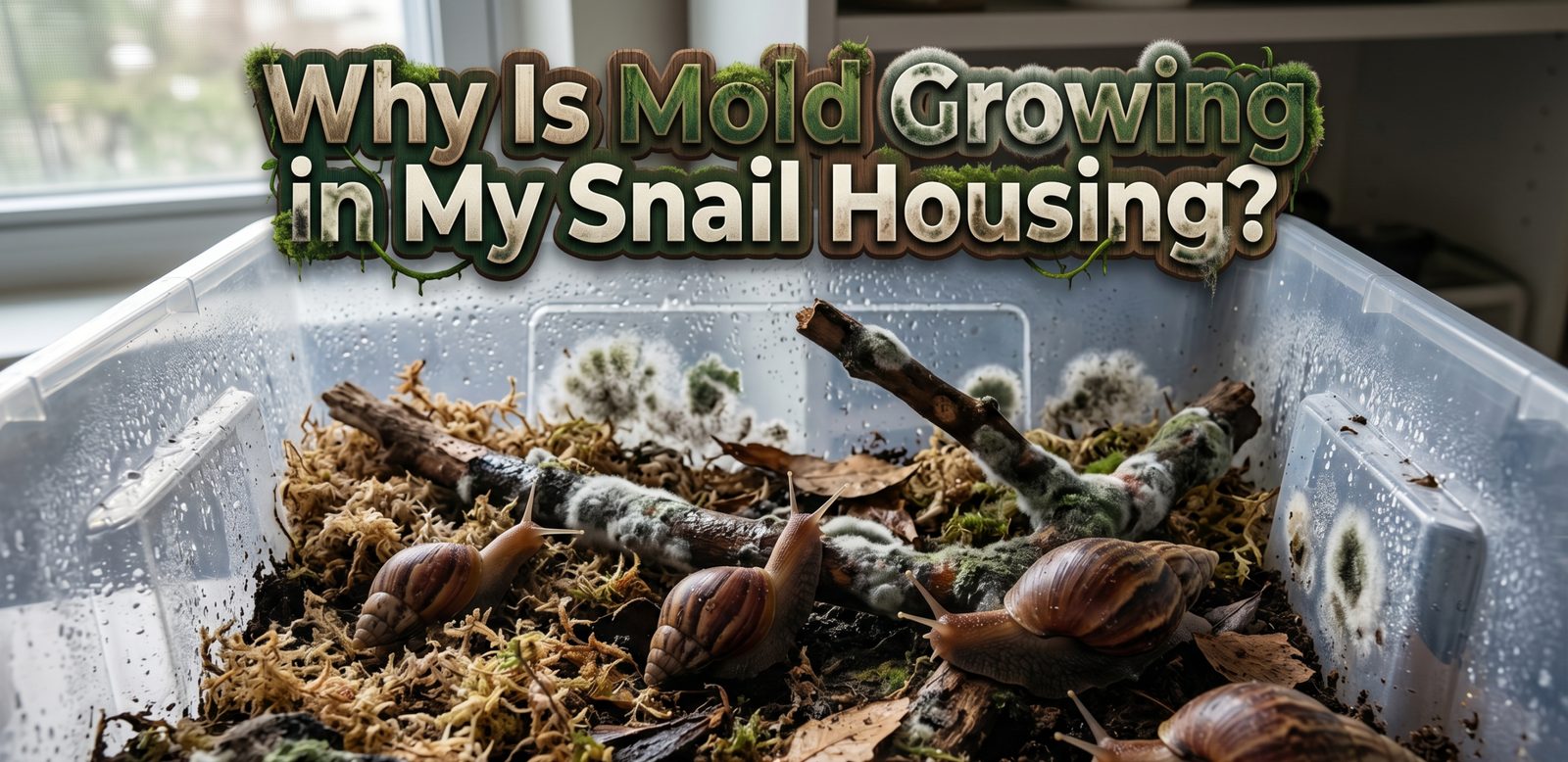
Mold in a snail enclosure is one of the most common problems snail keepers encounter, and it almost always points to the same handful of root causes: too much moisture, trapped air, and organic matter in warm conditions.
That mold is manageable, and in most cases, your snails are not in immediate danger.
What Causes Mold to Grow in a Snail Enclosure?
Mold spores are present in virtually every substrate, piece of wood, and leaf you introduce into an enclosure. They do not become a visible problem until conditions allow them to multiply. In snail housing, three conditions almost always drive mold growth:
Excess humidity with poor ventilation. Snails need humidity, typically between 70–90% depending on species, but that moisture needs to move. When an enclosure is sealed too tightly, condensation forms on every surface, and mold can colonize within 24–48 hours. A lid with no mesh or ventilation panel is the most common culprit.
Uneaten food left in the enclosure. Fresh vegetables, fruit, and protein foods decompose rapidly in a warm, humid environment. Mold begins forming on uneaten food within hours, particularly on soft fruit like bananas or melons. According to the Royal Horticultural Society, fungal growth accelerates significantly above 20°C (68°F), which is right in the range most keepers target for tropical snail species.
Substrate that retains too much water. Coco coir, peat, and soil mixes hold moisture well, which is desirable, but if the substrate is consistently waterlogged rather than evenly damp, anaerobic pockets form, and mold flourishes at the surface. Pouring water directly onto the substrate in one spot rather than misting the walls is a frequent mistake.
Organic decor that has not been treated. Driftwood, cork bark, dried leaves, and seed pods all carry fungal spores. Without proper preparation, baking, boiling, or sourcing from reputable reptile suppliers, these pieces become mold nurseries within days of being placed in a humid enclosure.
Is the Mold Dangerous to Snails?
Most surface mold that appears as white, grey, or pale tan fuzz is saprophytic mold, which feeds on decaying organic matter, not living tissue. This type is generally not directly harmful to snails.
Still, it signals that conditions in the enclosure are off, and prolonged exposure to heavily molded environments stresses snails and can indirectly compromise their immune response.
Black mold and certain dark green molds are a different matter. Mycotoxins produced by species such as Aspergillus and Stachybotrys can be harmful to invertebrates with sustained exposure. If you see dark mold spreading across the substrate or directly on your snail’s shell or foot, treat it as an urgent problem and clean the enclosure immediately.
The CDC’s guidance on mold confirms that mold growth indoors is driven by moisture, and the same principle applies in miniature inside an enclosure — control moisture and you control mold.
How to Get Rid of Mold in a Snail Enclosure
Step 1: Remove the snails first. Place them in a clean, temporary container lined with a damp paper towel and fitted with a ventilated lid while you clean. Do not rush this step; both cleaning products and disturbed mold spores pose risks.
Step 2: Remove all organic material. Take out decor, food dishes, hides, and any uneaten food. If the mold has spread significantly into the substrate, the substrate needs to be replaced entirely rather than spot-cleaned.
Step 3: Clean the enclosure walls. Wipe down the inside of the tank with plain hot water. For stubborn mold, a very diluted white vinegar solution (1 part vinegar to 4 parts water) is effective and safe, provided it is fully rinsed and dried. Avoid bleach if any residue could remain; bleach fumes and residue are toxic to snails.
Step 4: Treat or replace decor. Cork bark and wood pieces can be baked at 120°C (250°F) for 30–60 minutes to kill spores. Porous items that are heavily colonized should be discarded and replaced.
Step 5: Replace the substrate. Add fresh, properly moistened substrate. The right moisture level means the substrate clumps when squeezed but does not release water—a common benchmark called the “squeeze test” widely used in the herpetology community.
Step 6: Improve ventilation before returning the snails. Address whatever allowed mold to build up. If the lid has no ventilation, add a mesh panel. If the enclosure was too airtight, increase airflow passively.
How to Prevent Mold From Coming Back?
Preventing mold is fundamentally about managing the balance between humidity and airflow. Here is what works consistently:
Feed small portions and remove uneaten food within 12–24 hours. Fresh food should never sit overnight, especially protein sources like shrimp or eggs. Calcium supplements like cuttlebone are fine to leave in permanently since they do not decompose.
Mist the walls rather than the substrate. Directing mist toward the glass sides rather than the soil surface keeps the substrate appropriately damp without creating soggy spots where mold takes hold first.
Introduce isopods and springtails as a cleanup crew. This is the most effective long-term solution many experienced keepers use.
Springtails (Collembola species) eat mold spores and decaying matter at the substrate level, biologically suppressing mold before it becomes visible. Tropical white isopods serve a similar function.
According to The Isopod Authority, springtails are considered essential for any bioactive humid enclosure because of their mold-control function.
Increase cross-ventilation. A screen or mesh top alone may not be enough for particularly humid climates. Some keepers add a small USB fan nearby, set to a timer, to refresh air circulation around the enclosure once or twice per day.
Source substrate carefully. Pasteurized coco coir or commercially prepared bioactive substrates reduce the initial spore load. If you mix your own soil substrate, baking it at 90°C (195°F) for an hour before use kills most existing spores.
Monitor humidity with a digital hygrometer. Guessing humidity levels is one of the most common mistakes. A digital hygrometer (Govee and Inkbird offer well-reviewed, affordable options) provides accurate readings and alerts you when humidity is consistently above your target range.
Common Mold Types You Will See in Snail Enclosures
White fuzzy mold is the most common. Usually saprophytic; often appears first on decor and uneaten food. Remove the affected material, improve ventilation, and it will resolve quickly.
Grey mold (Botrytis) — associated with plant material and decaying leaves. Common in enclosures with live plants or leaf litter. Remove affected leaves and reduce leaf litter density.
Black pin mold — appears on substrate surface, often after overwatering. Indicates anaerobic conditions below the surface. Full substrate replacement is recommended.
Yellow or orange surface growth — sometimes slime mold rather than true fungal mold. Slime molds (Myxomycetes) are harmless organisms that appear in very moist conditions and can be removed manually.
Do Snails Eat Mold?
Some species, particularly land snails like Achatina and Cornu aspersum, will graze on certain types of mold and fungi as part of a varied diet. This is generally not harmful in small amounts, but it should not be relied on as a cleanup strategy.
A snail eating mold is a sign the enclosure has a moisture or food-removal problem, not a natural maintenance behavior to encourage.
When to Seek Help
If mold returns within days of a full clean and substrate replacement, the issue is structural; either the enclosure design does not support adequate ventilation for the required humidity level, or local ambient conditions (a particularly humid room, for example) make balance impossible.
In that case, consider moving the enclosure to a drier room, switching to a screen-sided enclosure for species that tolerate lower ambient humidity, or researching the specific humidity requirements of your snail species to ensure you are not over-humidifying unnecessarily.
The Snail World forum community and species-specific Facebook keeper groups are useful resources when troubleshooting persistent mold issues, as experienced keepers can often identify enclosure-specific problems from photos.
Final Thoughts
Mold growing in snail housing is almost always a ventilation and food-management problem. Identify which factor is driving it: sealed lid, uneaten food, waterlogged substrate, or untreated decor fix that root cause, and clean the enclosure thoroughly.
Adding a springtail cleanup crew is the most reliable long-term prevention strategy available, and it works passively without any ongoing effort. With the right setup, a mold-free snail enclosure is entirely achievable.